Thursday, October 11, 2007

Bebel Gilberto is (or, was) Starbuck's song of the day

Bebel GilbertoI have this album, but I haven't listened to it enough to form a strong opinion about it either way. I didn't think her last album was as good as the first, but that's probably because she didn't have the famed producer Cazuza as a collaborator.

Between Bebel and Ceu, someone at Starbucks seems to be really into Brazilian music.

Speaking of Ceu, she's coming to San Francisco on Nov. 3, which happens to be Andrea's and my first wedding anniversary. So we're going to the show. With the baby coming along, it'll probably be our last concert for a while.

Sunday, October 7, 2007

Another glowing review of the 2710p

An excerpt from tablet enthusiast site jkOnTheRun:

This new model is a design marvel that rekindles the love of using a Tablet PC, and that's why I bought one.

. . .

It is not only a great Tablet PC but also a stellar thin and light notebook computer, something that other OEMs have attempted to do but none as successfully as this in my book.  The hardware components are a decent compromise for providing great battery life while still providing very good performance, even under the resource hog that is Vista.  HP has done a good job making sure that the entire package works as flawlessly with Vista as anything I have seen yet.  The thin and light design is stellar at providing a great OOBE and daily usage.

Saturday, October 6, 2007

The 2710p vs. the x61

I feel a little more reassured now about my tablet PC purchase. The Houston Chronicle's tech guy reviewed the Lenovo x61 (the tablet I was considering for more than a year) and the HP 2710p head to head. Like me, he gave the 2710p the slight edge.

For me as a journalist, it really came down to two things: the 2710p's integrated microphone (for recording interviews) and the "night-light" feature, which illuminates the keyboard in dark rooms.

ASU in the New York Times

Guess what? ASU is crowded! And it's hard to find parking!

Stop the presses!

Monday, September 24, 2007

Busy, busy, busy

Posting will be a little lighter than usual over the next couple of weeks due o a confluence of events this week.

  • Season premiere of Heroes.
  • My discovery that Amazon.com is selling Battlestar Galactica season 3 downloads. Believe me, you won't find this (legally) anywhere else -- it's not even on DVD yet.
  • My Flash animation course at the local community college (which despite being online, actually has deadlines).
  • Halo 3, which assuming I've timed things right at GameFly, should be coming this week. To its credit, GameFly seems to have ordered many copies in anticipation of demand.

More news on the baby front: the chromosome tests came back today, and it's definitely a girl. Andrea, as you can probably imagine, is thrilled.

Newspapers should stop defining themselves as newspapers

News is about information, not the obsolete product it's printed on, says news consultant Vin Crosbie.

News organization that print news on wood pulp must stop defining themselves as 'newspapers' because that traditional definition intrinsically limits what they should do. Likewise, news organization that have always transmitted audio news clips on set schedules must stop defining themselves as 'news radio.' Etcetera.

...

However, the basic fact is that each is a news organization. The problem is they're internally organized to produce products that are becoming obsolete.

Obsolete? Yes, the likilihood is that consumers in the future won't want to receive a daily news report printed on wood pulp or even the online analogue of wood pulp (despite some video and animation added). Nor will consumers want to receive audio or video sent to them in a schedule or program line-up that they can't control or re-arrange. The era of the 'newspaper' in the United States, Canada, and many other countries, is over.

Couldn't have said it better myself.

Wednesday, September 19, 2007

Times Select Is free; Times Reader is not

I'm probably one of about 12 people who care, but the New York Times' decision to make all of its Web content free doesn't extend to its software Reader, which I've written about before.

That's too bad, Reader is something I might have used, but its not something I'd actually pay for.

Question:

Is it wrong to play a game designed for kids just for the easy achievement points? Or just lame?

Thursday, September 13, 2007

It's (probably) a girl!

Though we can't really be sure until the chromosome tests are complete, two sonograms on two continents seem to indicate that we're having a baby girl.

Everything looks good, and the baby looks healthy. And as you can see, she moves around in her sleep as much as I do.


P.S. After strolling through the "related videos" links, I see that sonogram videos could be considered their own subgenre on YouTube!

Wednesday, September 5, 2007

OneNote for Mac?

After a deluge of requests, Microsoft's Macintosh Business Unit is gauging users' interest in an OS X version of OneNote .

I didn't realize there were so many other fans of Microsoft's note-taking software out there. When I was considering getting a Mac, one of the things that kept me in the Windows camp was the thought of not being able to use OneNote natively (this was before Apple switched to Intel, making dual booting and robust virtualization possible). I completely agree with one of the comments on the page I linked to: OneNote is probably the single best piece of software Microsoft has ever produced.

Apparently, a lot of people like it as much as I do. This is quite a surprise, because it seems as though Microsoft barely promotes it. Most people I talk to have either never heard of it or think it's something you need a tablet PC to use. 

This Mac-love is even more surprising considering that the OS X version of Microsoft Word includes some of OneNote's main features, such as time-mapped audio recording.

Saturday, September 1, 2007

Time To Re-Learn Cursive

I finally got a new laptop computer, replacing my six-year-old

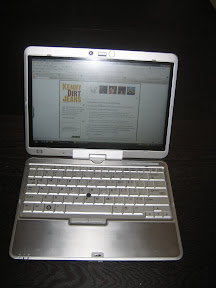
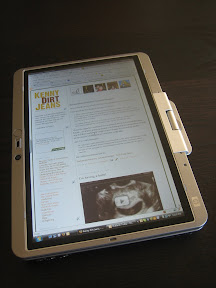
Sony Viao srx77p with HP's new 2710p convertible tablet. At about $1,900, it was pretty expensive for my budget (I've been saving up for more than a year), but I can safely say it is, by far, the finest laptop I have ever owned.

The purchase decision was a tight race between this and Lenovo's/IBM's ThinkPad x61s, also a convertible tablet. I was looking for an ultraportable tablet with a comfortable, full-sized keyboard and good battery life. Performance wasn't as much as a factor, though I wanted to get something that could handle Firefox, Word, Outlook and OneNote running simultaneously -- and still feel fast in a few years. And I knew I would need at least 2 gigabytes of memory to ensure Windows Vista ran smoothly.

I had read as many reviews as I could find. Most of the amateur/enthusiast sites were spot-on about the 2710p's strength and weaknesses. The least useful review, surprisingly, came from CNet, which slammed the 2710p for using a trackpoint-type cursor control -- something that barely warranted a mention in Cnet's "Editor's Choice" review of the Lenovo X60 (each was written by a different staffer).

Here's my quick-and-dirty summary judgement of the 2710p.

The good: The 2710p is light, sports a decent battery life and has a keyboard that rivals Lenovo's legendary feel. It also packs some handy features Lenovo lacks, such as built-in camera, integrated dual-array microphone (which means I can easily record in-personal interviews via OneNote) and a pop-out "night light" that illuminates the keyboard when it's dark -- this will come in very handy when I'm covering keynote speeches at tech conventions. And then there's the wow factor -- it looks stunning.

The bad, as well-documented in most of the online reviews:

  • the power switch is hard to slide, as is the screen latch.
  • There's no easy screen-rotation button accessible in both laptop and tablet modes (the screen rotates when you "transform' the machine from a laptop into a tablet and vice-versa, but if you shut it down in tablet mode and decide to fold it into laptop form when putting it away, it could boot up in the wrong orientation).
  • The ambient light sensor, which saves battery power by ensuring that the screen is no brighter than it needs to be, is in the worst possible place. In tablet mode, most people will wind up placing their arm over the sensor when writing, constantly dimming the screen.
  • The digitizer pen pops out too easily. It still takes force to pull the pen completely out of its holster, but I'm still worried about losing it.

Still, I'm pretty happy with my purchase. I'm not sure how the machine will stack up against Lenovo's famously tough machine in terms of durability, but the marketing material listed several features designed to put business users at ease: DuraKeys, chemically strengthened glass on the screen, and a motion sensor that parks the hard-drive head to protect the machine when it's dropped or jostled. The case is also made of a magnesium alloy, which is supposed to be pretty tough for its weight, and coated with something called DuraFinish to keep it looking newer longer. And did I mention how nice it looks?

Finally, about the cursive. I've been using the tablet feature, and the handwriting recognition is atrocious -- even after I spent an hour training it to learn my style. Maybe it's me, but no matter what I do, it just won't recognize my lower-case a's, lowercase d's and a few other stubborn letters.

But it reads my cursive script, which is quite messy, flawlessly. So I'm re-training myself to write in cursive. This is not as easy as it sounds. I know cursive is probably much more efficient, but for some reason, I've always preferred block letters, even after I became a newspaper reporter. (Thanks to the Internet, I now see I'm not the only one who feels this way).

Here's what's wrong with cursive: capital U's and V's, which are far too similar; the awkward capital T; the goofy-looking, three-humped lowercase m; and the stupidest cursive letter of all time -- the capital Q. Lowercase k's, meanwhile, have become the bane of my existence.

Wish me luck.

My (not-so-hot) photos:

Monday, August 27, 2007

Embattled Attorney General Resigns

This comes about six months too late, but at least it's finally happening.

I was struck by this detail of the news accounts:

A senior administration official said today that Gonzales, who was in Washington, had called the president in Crawford, Tex., on Friday to offer his resignation. The president rebuffed the offer, but said the two should talk face to face on Sunday.

Gonzales and his wife flew to Texas, and over lunch on Sunday the president accepted the resignation with regret, the official said.

I hope the reporters confirmed this narrative, because it sounds like pure fiction -- or at best, political theater. I'm betting that the resignation was part of a deal Bush made with Congress in exchange for expanding the the government's wiretapping powers a few weeks ago.

And I love this little gem:

On Saturday night, Gonzales was contacted by his press spokesman to ask how the department should respond to inquiries from reporters about rumors of his resignation, and Gonzales told the spokesman to deny the reports.

He couldn't resist one last lie.

Embattled Attorney General Resigns - New York Times

Saturday, August 18, 2007

I'm having a baby!

Actually, Andrea is. But I helped!

Now that we've passed the crucial 12-week mark, we're entering our public beta phase.

Sunday, August 12, 2007

10 AMAZING ways to get your article on Digg!!!!!

Remember the days when a journalist could just write a story and leave all the editing, publishing, promotion and distribution to other people on your newspaper staff? No longer.

In this crazy Web 2.0 world of ours, everyone is a one-man news operation. And if you want to get read, you've got to get dugg. So here are some helpful pointers on how to get noticed by Digg and other social bookmarking sites.

1. Break your article into a numbered list of easy-to-digest snippets. People love top-10 lists, how-to's and collections of Web sites, software, etc.

2. Hype Promote the article's contents (see headline above). Little words like "amazing," "unbelievable," "mind-blowing," etc., go a long way. And use at least five exclamation points in the headline (any combination will do; you can spread them throughout the headline or save them up for a big bang at the end). And don't forget to CAPITALIZE key words!

Bonus tip: Combinations of these techniques can be especially powerful. Trust me!! You'll get INCREDIBLE results!!!

3. The best predictor of future performance is past performance, right? So don't be afraid to repeat yourself or previous Digg posts. Most people have short attention spans and need to be reminded of things. If someone points out the dupe, argue that there might have been someone, somewhere in the universe who hasn't read it before and it therefore deserves to be a top-rated story.

4. Rumors -- no matter how ridiculous, poorly sourced, silly or illogical -- are fair game. And there's nothing wrong with making wildly speculative claims or draw overreaching conclusions about minor new developments. Accuracy is highly overrated.

5. Apple, Google, Digg, Kevin Rose! Apple, Google, Digg, Kevin Rose! Apple, Google, Digg, Kevin Rose! Apple, Google, Digg, Kevin Rose! Apple, Google, Digg, Kevin Rose! Apple, Google, Digg, Kevin Rose! Apple, Google, Digg, Kevin Rose! Apple, Google, Digg, Kevin Rose! Apple, Google, Digg, Kevin Rose!Apple, Google, Digg, Kevin Rose!

6. Linux rules; Microsoft sucks. The sooner you get that through your head, the happier you'll be.

7. Make more friends. Or submit your own articles.

8. To draw in more readers be as vague as possible in the headline and the summary. Examples: "Something very INTERESTING is going on at Google!!!!!" and "What will those Japanese inventors think of NEXT!?!?!?!?!?!? The answer may surprise you..."

9. People like nice, round numbers. So if do don't have enough material, fill the list with something lame. Like this.

10. The best predictor of future performance is past performance, right? So don't be afraid to repeat yourself or previous Digg posts. Most people have short attention spans and need to be reminded of things. If someone points out the dupe, argue that there might have been someone, somewhere in the universe who hasn't read it before and it therefore deserves to be a top-rated story.

Share this post :

Friday, August 10, 2007

Saturday, July 28, 2007

Google mobile

I noticed today that links to New York Times stories from Google's personalized mobile homepage go straight to the Times' mobile Web site rather than Google's "mobilized" version (where Google intercepts and reformats the regular site for mobile phone users).

I like this. As handy as Google's reformatting is for many sites, I'd rather see the true mobile version for sites that have one.

Monday, July 23, 2007

I know (semi)-famous people!

Andrea's first multimedia project appeared online today (she did all the 3-D stuff and helped with some of the other things).

And a friend's Web site, CostHelper.com, got mentioned in the Wall Street Journal.

Kudos all around.

Saturday, July 21, 2007

Live Search for Mobile

Microsoft has updated Live Search Mobile, a search and mapping application for Windows Mobile- and Java-equipped phones. The new version offers movie showtimes, better GPS support and the ability to cache previously viewed maps for faster performance.

It's a lot like Google Maps Mobile, though if forced to choose, I'd have to give a slight edge to Microsoft on this one. Though I prefer Google Maps on my PC -- it's the snappiest online mapping service by far -- I've always liked the way Microsoft/MSN/Live maps look. It's the closest thing I've seen to "real" paper maps. Now, I can get the maps I like in a service that's just as fast as Google's alternative.

Anyway, both are handy little applications to have on your phone.

Separately, Microsoft also updated its Live Search Web service for mobile phones. Among other things, the new version lists search results across multiple categories, much like Google's standard PC Web search. It's pretty handy -- I'm not sure why Google doesn't do the same thing its mobile searches.

Still, Google's mobile search gave me much better results in two quick tests.

On Google, a phone search for "7-11" listed nearby stores -- Microsoft gave me what looked like completely random results.

A Google search on "Harry Potter," meanwhile, gave me local showtimes for the movie, a couple of recent news stories, J.K. Rowling's official site, the official Harry Potter site, the Wikipedia entry and more. Microsoft gave me the Wikipedia entry, some photos (a nice touch, actually). It had a space for news stories and local results (showtimes, etc.) but they were empty -- despite knowing my home address. So Google was far more useful in both situations.

It seems Microsoft has a little more work to do.

The Future of Journalism, part 534

"Recovering Journalist"  Mark Potts notes the Wall Street Journal's precipitous revenue plunge, but worries more about the industry's lackluster and unimaginative response so far.

His ideas, paraphrased:

  • Accept that the Web and mobile devices are your primary publishing platform, not the printing press. Even better, stop printing the newspaper altogether and move entirely to the Web.
  • Get local. Very local.
  • Embrace user-generated content and bring readers into the conversation.
  • Give readers' social networking tools to help that them interact and flourish under your banner.
  • Find ways to make your company essential to your advertisers' businesses by providing them with non-advertising services.

I don't quite agree with that last point, especially when he gets into some of the specifics he has in mind. But the rest of it is spot on.

 Meanwhile, Scott Karp of Publishing 2.0 notes what he calls the "10% problem" newspapers face going online. 

What you find, with some modest rounding, is that print circulation is about 10% of total audience reach, while online advertising revenue is 10% of total ad revenue — the economics are nearly the perfect inverse of what they should be.

In other words, it's not newspapers that are lagging in this technology transition -- it's advertisers.

Maybe the industry is trained to think that, for display ads, bigger is better. Many are resistant to newspapers publishing in a tabloid-sized format for the same reason -- they don't want to pay the same amount of money for smaller ads.

Maybe newspapers are fetching less for online ads just because that's all they're worth. With online ads, advertisers know exactly what they're getting for their money.

Maybe they're realizing that they've been overpaying for decades.

In any case, I hope my industry, to paraphrase of Jeff Jarvis, can survive long enough to solve this dilemma.