Showing posts with label journalism. Show all posts

Wednesday, June 20, 2012

A modest proposal for gadget reviews

If I ran a technology product-review blog, I'd have a regular feature called "The Six-Month Checkup." It would basically be an addendum to every previous initial gadget review, detailing how well a product is holding up over time. Such a feature would let reviewers get better acquainted with a product -- its annoyances, reliability issues and even little surprise features that don't always make it into the press materials.

As a onetime/longtime technology journalist, I know the pressures of product reviews: your readers and editors want them immediately, and six-month-old gadgets aren't exactly eyeball magnets. But I think there's an audience that -- whether for reasons of frugality or conservation -- is looking to make careful long-lasting purchases. And for this audience, the Six-Month Checkup is just what the doctor ordered.

Thursday, September 4, 2008

MSNBC’s election logo looks like Bank of America’s

An eerie similarity -- or is it just me?


image    

image

Sunday, May 11, 2008

Livescribe Pulse Smartpen

I mentioned this electronic pen in a story I did a while ago about note-taking tools, but it looks like it's finally out for sale.

It's a pen that records your handwriting at the same time as it records audio. So in addition to your written notes, you have an actual recording to refer to later. After you're done with, say, an interview or class, you can point to a particular place on the paper, and the pen plays back what you were recording at the time -- sort of like OneNote for paper.

The pen also makes it easy to transfer note to your PC and upload them to the Internet to share, audio and all. I wish OneNote were as easy to share.

This could be a seriously cool tool for journalists -- I'd get one myself if the price were a little lower. If anything ever happed to my 2710p, I'd seriously consider buying a cheap laptop replacement and one of these Smartpens.

The Pulse does need special paper, and it doesn't look like they sell a reporter's notepad. They do sell a Moleskin-type journal pad that cost $25. Ouch. The company says you'll soon be able to print out your own special paper on any laser printer.

Reviews: Gizmodo, New York Times.

Tuesday, January 8, 2008

The four stages of CES

Stage 1: Denial

Set up every possible appointment you can. That's the whole point of a conference, right?

Stage 2: Shock

Sudden realization that you might not have much time to walk the show floor, eat or go to the bathroom because you've set up too many appointments.

Stage 3: Bargaining

Running progressively later for appointments, make apologetic phone calls, try to rearrange schedule.

Stage 4: Acceptance

Brazenly skip every other appointment; use the extra time to run to remaining appointments.

Sunday, December 30, 2007

Journeyman is actually a pretty good show

I didn't really like the first couple of episodes of this series about a San Francisco journalist/time traveler, but kept recording it for some reason. With a dearth of new programming on due to the writers strike, I finally got around to watching the shows piling up on my Windows Media Center. And you know what? Journeyman really grows on you.

Now I'm all caught up on the first half of the season and can't wait for the second half to begin. I hope it doesn't get canceled. It's one of the more sophisticated sci-fi shows I've seen on TV (one of the strengths of Battlestar Galactica) in a while -- and has been far better than season 2 of Heroes so far.

Or maybe I'm just a sucker for sci-fi stories centered around journalists.

Update: Oops. Too late.

Tuesday, October 23, 2007

Since when does an Osama story call for a "wacky" headline?

From the Washington Post's Web site today:image

Do they have interns working at the copy desk or something?

Saturday, October 6, 2007

The 2710p vs. the x61

I feel a little more reassured now about my tablet PC purchase. The Houston Chronicle's tech guy reviewed the Lenovo x61 (the tablet I was considering for more than a year) and the HP 2710p head to head. Like me, he gave the 2710p the slight edge.

For me as a journalist, it really came down to two things: the 2710p's integrated microphone (for recording interviews) and the "night-light" feature, which illuminates the keyboard in dark rooms.

Monday, September 24, 2007

Newspapers should stop defining themselves as newspapers

News is about information, not the obsolete product it's printed on, says news consultant Vin Crosbie.

News organization that print news on wood pulp must stop defining themselves as 'newspapers' because that traditional definition intrinsically limits what they should do. Likewise, news organization that have always transmitted audio news clips on set schedules must stop defining themselves as 'news radio.' Etcetera.

...

However, the basic fact is that each is a news organization. The problem is they're internally organized to produce products that are becoming obsolete.

Obsolete? Yes, the likilihood is that consumers in the future won't want to receive a daily news report printed on wood pulp or even the online analogue of wood pulp (despite some video and animation added). Nor will consumers want to receive audio or video sent to them in a schedule or program line-up that they can't control or re-arrange. The era of the 'newspaper' in the United States, Canada, and many other countries, is over.

Couldn't have said it better myself.

Saturday, September 1, 2007

Time To Re-Learn Cursive

I finally got a new laptop computer, replacing my six-year-old

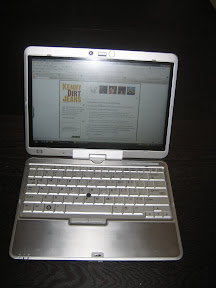
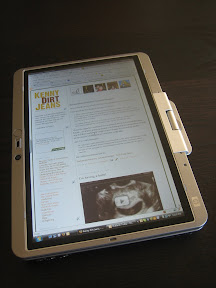
Sony Viao srx77p with HP's new 2710p convertible tablet. At about $1,900, it was pretty expensive for my budget (I've been saving up for more than a year), but I can safely say it is, by far, the finest laptop I have ever owned.

The purchase decision was a tight race between this and Lenovo's/IBM's ThinkPad x61s, also a convertible tablet. I was looking for an ultraportable tablet with a comfortable, full-sized keyboard and good battery life. Performance wasn't as much as a factor, though I wanted to get something that could handle Firefox, Word, Outlook and OneNote running simultaneously -- and still feel fast in a few years. And I knew I would need at least 2 gigabytes of memory to ensure Windows Vista ran smoothly.

I had read as many reviews as I could find. Most of the amateur/enthusiast sites were spot-on about the 2710p's strength and weaknesses. The least useful review, surprisingly, came from CNet, which slammed the 2710p for using a trackpoint-type cursor control -- something that barely warranted a mention in Cnet's "Editor's Choice" review of the Lenovo X60 (each was written by a different staffer).

Here's my quick-and-dirty summary judgement of the 2710p.

The good: The 2710p is light, sports a decent battery life and has a keyboard that rivals Lenovo's legendary feel. It also packs some handy features Lenovo lacks, such as built-in camera, integrated dual-array microphone (which means I can easily record in-personal interviews via OneNote) and a pop-out "night light" that illuminates the keyboard when it's dark -- this will come in very handy when I'm covering keynote speeches at tech conventions. And then there's the wow factor -- it looks stunning.

The bad, as well-documented in most of the online reviews:

  • the power switch is hard to slide, as is the screen latch.
  • There's no easy screen-rotation button accessible in both laptop and tablet modes (the screen rotates when you "transform' the machine from a laptop into a tablet and vice-versa, but if you shut it down in tablet mode and decide to fold it into laptop form when putting it away, it could boot up in the wrong orientation).
  • The ambient light sensor, which saves battery power by ensuring that the screen is no brighter than it needs to be, is in the worst possible place. In tablet mode, most people will wind up placing their arm over the sensor when writing, constantly dimming the screen.
  • The digitizer pen pops out too easily. It still takes force to pull the pen completely out of its holster, but I'm still worried about losing it.

Still, I'm pretty happy with my purchase. I'm not sure how the machine will stack up against Lenovo's famously tough machine in terms of durability, but the marketing material listed several features designed to put business users at ease: DuraKeys, chemically strengthened glass on the screen, and a motion sensor that parks the hard-drive head to protect the machine when it's dropped or jostled. The case is also made of a magnesium alloy, which is supposed to be pretty tough for its weight, and coated with something called DuraFinish to keep it looking newer longer. And did I mention how nice it looks?

Finally, about the cursive. I've been using the tablet feature, and the handwriting recognition is atrocious -- even after I spent an hour training it to learn my style. Maybe it's me, but no matter what I do, it just won't recognize my lower-case a's, lowercase d's and a few other stubborn letters.

But it reads my cursive script, which is quite messy, flawlessly. So I'm re-training myself to write in cursive. This is not as easy as it sounds. I know cursive is probably much more efficient, but for some reason, I've always preferred block letters, even after I became a newspaper reporter. (Thanks to the Internet, I now see I'm not the only one who feels this way).

Here's what's wrong with cursive: capital U's and V's, which are far too similar; the awkward capital T; the goofy-looking, three-humped lowercase m; and the stupidest cursive letter of all time -- the capital Q. Lowercase k's, meanwhile, have become the bane of my existence.

Wish me luck.

My (not-so-hot) photos:

Sunday, August 12, 2007

10 AMAZING ways to get your article on Digg!!!!!

Remember the days when a journalist could just write a story and leave all the editing, publishing, promotion and distribution to other people on your newspaper staff? No longer.

In this crazy Web 2.0 world of ours, everyone is a one-man news operation. And if you want to get read, you've got to get dugg. So here are some helpful pointers on how to get noticed by Digg and other social bookmarking sites.

1. Break your article into a numbered list of easy-to-digest snippets. People love top-10 lists, how-to's and collections of Web sites, software, etc.

2. Hype Promote the article's contents (see headline above). Little words like "amazing," "unbelievable," "mind-blowing," etc., go a long way. And use at least five exclamation points in the headline (any combination will do; you can spread them throughout the headline or save them up for a big bang at the end). And don't forget to CAPITALIZE key words!

Bonus tip: Combinations of these techniques can be especially powerful. Trust me!! You'll get INCREDIBLE results!!!

3. The best predictor of future performance is past performance, right? So don't be afraid to repeat yourself or previous Digg posts. Most people have short attention spans and need to be reminded of things. If someone points out the dupe, argue that there might have been someone, somewhere in the universe who hasn't read it before and it therefore deserves to be a top-rated story.

4. Rumors -- no matter how ridiculous, poorly sourced, silly or illogical -- are fair game. And there's nothing wrong with making wildly speculative claims or draw overreaching conclusions about minor new developments. Accuracy is highly overrated.

5. Apple, Google, Digg, Kevin Rose! Apple, Google, Digg, Kevin Rose! Apple, Google, Digg, Kevin Rose! Apple, Google, Digg, Kevin Rose! Apple, Google, Digg, Kevin Rose! Apple, Google, Digg, Kevin Rose! Apple, Google, Digg, Kevin Rose! Apple, Google, Digg, Kevin Rose! Apple, Google, Digg, Kevin Rose!Apple, Google, Digg, Kevin Rose!

6. Linux rules; Microsoft sucks. The sooner you get that through your head, the happier you'll be.

7. Make more friends. Or submit your own articles.

8. To draw in more readers be as vague as possible in the headline and the summary. Examples: "Something very INTERESTING is going on at Google!!!!!" and "What will those Japanese inventors think of NEXT!?!?!?!?!?!? The answer may surprise you..."

9. People like nice, round numbers. So if do don't have enough material, fill the list with something lame. Like this.

10. The best predictor of future performance is past performance, right? So don't be afraid to repeat yourself or previous Digg posts. Most people have short attention spans and need to be reminded of things. If someone points out the dupe, argue that there might have been someone, somewhere in the universe who hasn't read it before and it therefore deserves to be a top-rated story.

Share this post :

Monday, July 23, 2007

I know (semi)-famous people!

Andrea's first multimedia project appeared online today (she did all the 3-D stuff and helped with some of the other things).

And a friend's Web site, CostHelper.com, got mentioned in the Wall Street Journal.

Kudos all around.

Saturday, July 21, 2007

The Future of Journalism, part 534

"Recovering Journalist"  Mark Potts notes the Wall Street Journal's precipitous revenue plunge, but worries more about the industry's lackluster and unimaginative response so far.

His ideas, paraphrased:

  • Accept that the Web and mobile devices are your primary publishing platform, not the printing press. Even better, stop printing the newspaper altogether and move entirely to the Web.
  • Get local. Very local.
  • Embrace user-generated content and bring readers into the conversation.
  • Give readers' social networking tools to help that them interact and flourish under your banner.
  • Find ways to make your company essential to your advertisers' businesses by providing them with non-advertising services.

I don't quite agree with that last point, especially when he gets into some of the specifics he has in mind. But the rest of it is spot on.

 Meanwhile, Scott Karp of Publishing 2.0 notes what he calls the "10% problem" newspapers face going online. 

What you find, with some modest rounding, is that print circulation is about 10% of total audience reach, while online advertising revenue is 10% of total ad revenue — the economics are nearly the perfect inverse of what they should be.

In other words, it's not newspapers that are lagging in this technology transition -- it's advertisers.

Maybe the industry is trained to think that, for display ads, bigger is better. Many are resistant to newspapers publishing in a tabloid-sized format for the same reason -- they don't want to pay the same amount of money for smaller ads.

Maybe newspapers are fetching less for online ads just because that's all they're worth. With online ads, advertisers know exactly what they're getting for their money.

Maybe they're realizing that they've been overpaying for decades.

In any case, I hope my industry, to paraphrase of Jeff Jarvis, can survive long enough to solve this dilemma.

Sunday, July 15, 2007

Journalism as a service

In a post about the fight at the L.A. Times about whether to run front-page ads, Jeff Jarvis makes an interesting point about journalism as a service vs. journalism as a product.

But what is the LA Times as a local brand and service — note: service vs. product — going to look like in five years and how is it going to get there? How can it get far more local than it is today? How can it build broader networks of people and content and advertising? How can it pay for all that development and experimentation? And how can it survive long enough to get there?

While the distinction may seem semantic, I think the industry's mistaken impression of itself underlies its fear and loathing of readers' migration online.

As a product, newspapers are doomed -- and their demise is coming a lot faster than many of us realize. But as a service, journalism and the journalism business have unprecedented opportunity. The sooner journalists start thinking of their business as a service, the better equipped they'll be for the changes ahead.

Source: BuzzMachine

Sunday, July 1, 2007

The inevitable iPhone post

Actually, this post is about the ultimate reporter's tool, which I'm not quite convinced is the iPhone.

I've been thinking about this topic since last year, when I got the Hewlett-Packard iPaq 6915 smart phone. I do all kinds of journalism-related tasks with it, including getting directions (Via the built-in GPS), sending and receiving e-mail, surfing the Web (painfully) and recording interviews when I don't have access to my OneNote-equipped laptop. In a pinch, I could even write and file a short story with it. I've actually gotten pretty proficient on the tiny keyboard. (I'm writing this post with it from a park.)

Still, it's far from perfect. The camera isn't good enough for newspaper-ready photos (or Web site-ready, for that matter), and the mobile version of OneNote isn't nearly as useful as the full version. I've tried taking notes with it, and it wasn't pretty.

From what I've seen, the iPhone is even more flawed as a reporter's tool. But it got me thinking again about how close this ultimate device might be to reality and what it might mean for my industry. What will the newsroom of the future look like? And will everyone be a potential journalist?

Tuesday, June 19, 2007

Newspapers Should Embrace Online Aggregators

Amen. 

The problem that newspapers and other traditional media brands have is that they still see branding as a function of controlling the distribution channel, rather than branding each unit of content that must now live and survive on its own in a disaggregated online media ecosystem.

But the real missed opportunity for newspapers is in optimizing their content to convert user who find their way to newspaper content via search and other aggregators into subscribers and direct users of the brand. The New York Times, having learned from search master About.com, is using this approach with its Times Topics pages, which rank high in Google for generic terms and draw users in to the universe of NYT content.

Source: Publishing 2.0

Monday, June 11, 2007

Courier-Journal reporter ejected from U of L game

For once, resistance to change isn't coming from a newspaper:

A Courier-Journal sports reporter had his media credential revoked and was ordered to leave the press box during the NCAA baseball super-regional yesterday because of what the NCAA alleged was a violation of its policies prohibiting live Internet updates from its championship events.

Sunday, June 3, 2007

10 obvious things about the future of newspapers you need to get through your head

There is hope. Ryan Sholin, a  graduate journalism student at San Jose State University, spells out a few realities that somehow seem to elude most veteran news people. Here's a summary of his well-argued diatribe.

  1. It’s not Google’s fault.
  2. It’s not Craig’s fault.
  3. Your major metro newspaper could probably use some staff cuts.
  4. It’s time to stop handwringing and start training.
  5. You don’t get to charge people for archives and you certainly don’t want to charge people for daily news content.
  6. Reporters need to do more than write. The new world calls for a new skillset, and you and Mr. Notebook need to make some new friends, like Mr. Microphone and Mr. Point & Shoot.
  7. Bloggers aren’t an uneducated lynch mob unconcerned by facts. They’re your readers and your neighbors and if you play your cards right, your sources and your community moderators. If you really play it right, bloggers are the leaders of your networked reporting projects. Get over the whole bloggers vs. journalists thing, which has been pretty much settled since long before you stopped calling it a “Web blog” in your stories.
  8. You ignore new delivery systems at your own peril. RSS, SMS, iPhone, e-paper, Blackberry, widgets, podcasts, vlogs, Facebook, Twitter — these aren’t the competition, these are your new carriers.
  9. J-schools can either play a critical role in training the next generation of journalists, or they can fade into irrelevancy. Teach multimedia, interactivity and data, or watch your students become frustrated and puzzled as they try to get jobs with five clips and a smile.
  10. Okay, here comes the big one: THE GLASS IS HALF FULL.

I wish this were written by a major news executive instead, but at least some journalists seem to get it.